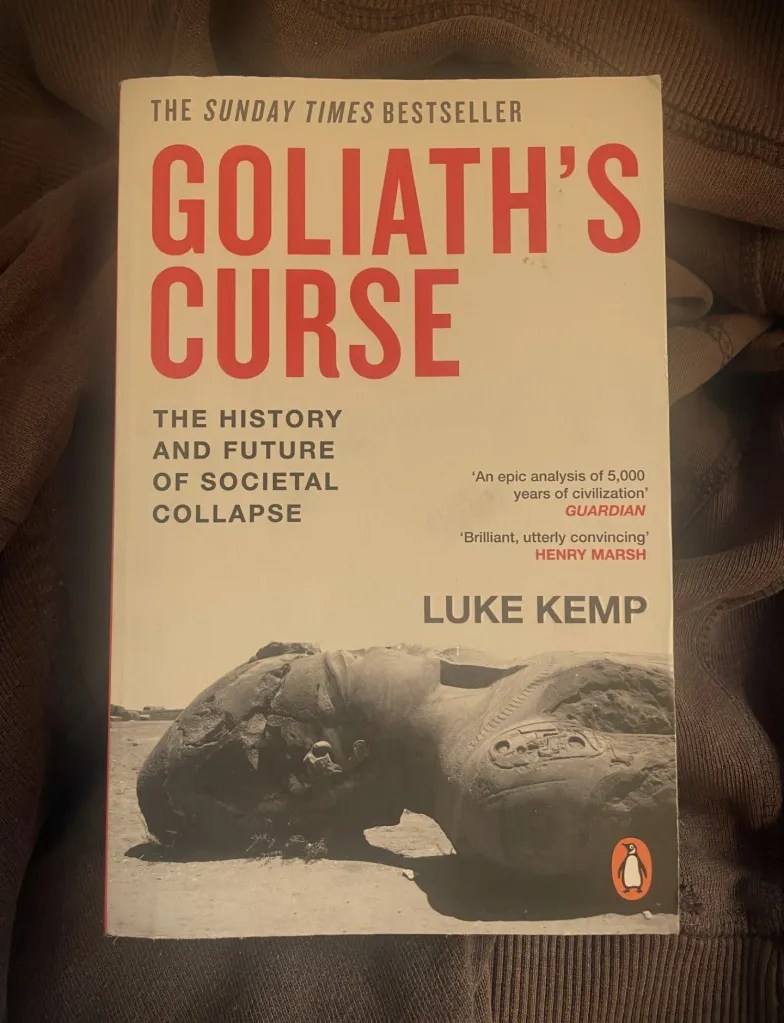
(Some engagement with Luke Kemp’s Goliath’s Curse and it’s implication for the Martial current). https://www.cser.ac.uk/team/luke-kemp/
I’ve experienced several independence-day celebrations in various countries—all celebrating independence from my own government. I’m used to grappling with the history of empire and the shabby excuses for contemporary global inequalities. And while that history is not without unabashed cruelty, I’m resistant of accepting the blanket destain of all involved/supportive. It’s hard now to imagine the psychological context of centauries gone, when Gods, curses and death were near—and information slow, and so prone to manipulation. Similarly, the lines of conqueror and conquered are less than distinct. Just as ‘developmental aid’ can enforce power structures of ex-colonised structures to the detriment of their disempowered citizens,(1) so too, reading Blincoe (2)/Jack London (3) one can see that, for someone at the lower end of hierarchy of a colonising country, the boons of wealth extraction from other nations is only empowers the boots of the elites at their neck more firmly. The relative boons depend on how one measures… I imagine its much like today: one gets food and lodgings and entertainment, and little power to change anything of consequence. And the food and lodgings slowly diminish. And, well, ‘of course’ we had to defeat Catholic Spain, ‘of course’ we had to defeat France, then Germany. And here comes an image that has stuck more fervently: two great dragons emerging, trampling on everything as they fight. And, as violence does, every wound only assured the one dragon that the other is the worst evil. And the dragons grow larger and larger—and the boons of neutral lands will assuredly be gobbled up by one’s advisory if one doesn’t do it first. And as these two dragons grow bigger, absorbing nation after nation; one watches their approach, and one is stuck, a peasant in the Game of Thrones, between a few pertinent considerations:
- Neutral land will just be absorbed by the first dragon that gets to it, but perhaps the best one can do is to make it expedient for all dragons to slaughter people in a more human manner? (The call for mercies)
- The manner of one dragon is marginally less evil than the other—so we should join forces with them. (The moral soldier).
- It is inevitable now that the bigger of the dragons will win—so we should side with them that the conflict is over sooner. (The expedient soldier).
- I’ve shaken a moral code out of an old religious book, the best I can do is obey, say my prayers, and assume the ‘rights’ of this despite whatever visible consequences appear. (The idealistic soldier). Though this is close to thinking ‘I understand the long-term picture—and I’ll hedge my bets with this third dragon, whom I know will come to rule eventually.
It is interesting then to see that someone has put the name Goliath to these dragons, and studied its emergence. A related term is that of civilisation—an aggregation of features that is not well defined: writing, complexity, hierarchy, scale; GC (Goliath’s Curse) gives examples where some, but not all, of these hallmarks are present. Perhaps most pertinent is the more amiable attribute of civilisation with restraint. The superficiality of this attribute is highlighted by all that Kemp presents in Hobbe’s Delusion. In this first third of GC though, primarily shows that, before twelve-thousand years or so (with a bit of triangulation looking at more contemporary hunter-gatherer societies as are our closest equivalent to lifestyles then), the evidence of inter-human violence is relatively scant. It also suggests the importance of Goliath fuel (conditions allowing central control of arms/food/movement) emerging with the warmer climate (e.g. the ability to grow wheat with its very visible production and potential to be taken and stored for long periods). These conditions hyper-empower status-competition (essentially of men) with bigger winners and bigger losers; and so also lead to a particular type of person emerging in control, control consolidated with displays of prestige/power, often encompassing tortures and execution. Something of a lifecycle of a ‘Goliath’ is also depicted with examples (interestingly 1990s Somalia) of civilisational collapse being a considerable boon to the average ‘citizen’ who is released from oppressive/extractive systems.
I’ll leave the details to the GC, but at the very least we are lacking evidence that ‘the grim darkness’ of prehistory was ‘only war’; and this represents a worldview that is a significant shift from (for us in Europe) largely Roman-articulated descriptions of pre-Christian carnage; even if these are taken at face value, the point made by GC is that the legitimacy of conquest and Ariesian/Martial adoration appears to be a relatively recent development. It has been easy to imagine, as Hobbes did, that the violence/conquest which has strong depictions in the mythology of Norse, Saxon, Celt, Roman and, to a slightly lesser extent, Greek origins, represented a continuum of decreasing violence, or at least violence as a pre-civilisation status-quo. If one goes back even further to our nearer animal relations, one can pick examples either way: chimps are more violent and better adapted to deal and endure violence; bonobos are chill and promiscuous.
The idealised use of the term ‘Civilisation’ presents it as being in opposition to violence. Though violence is accepted it is couched in regret and framed as more acceptable when dealt out in terms of discipline and strategy rather than an outcome of emotional intoxication (re-enforcing the implication that it is done out of rational necessity rather than desire). GC denies this framing of ‘civilisation’ as a uniquely benevolent yolk emerging within a shell of violence that is necessary to keep out the barbarism of all that came before.
The peace in Empires’ centre more frequently appears as a transient state where the majority have enough necessities that they will tolerate resource extraction from themselves, though it strengthens their own subjugation. To some degree this is a barter we all make; weighing compromise with the risks of chaos and the potential for a nastier dragon to emerge steering our ship. This predicament is contrasted to the low-violence, high respect-for-fellow-human vision of life prior to 12,000 years ago: the Pre-Holocene-Goodlife (for ease I’ll refer to this as PreHGood). The point made is that a lot that we would consider attributes of civilisation (organisation, obedience to law, complexities of trade, tax etc.) would be better seen as part of the story of war, conquest and domination which, in certain areas, allowed elements of PreHGood to re-emerge. Something that seems a little understated is the growth in science and knowledge that seem to have largely emerged from having a Goliath structures elite with time and money to spare. However badly humanity has used this knowledge, and despite tendencies for the focus of knowledge-seeking to be bent to elite empowerment, there are plenty of boons (whether in medicine or simply the ability to establish historical evidence): greater knowledge, living closer to the reality of consequences, is a moral step forward. Don’t be an idiot.
Later volumes of Tramps. particular look at the function of chivalry/Arthurian Romance in presenting a Martial reform of Christian virtue to feed the Crusades (a reform that must have appeared absurd to Jesus as the idea of him bartering military victory for Constantine’s conversion to Christianity). Volume II of Tramps. though looks more broadly at demarking a ‘natural good.’ Here it would be comforting to think that this PreHGood is our ‘natural’ (with the connotation of legitimacy that entails) manner of being.
There’s another point though—running through all the Tramps. books: What about Bathory’s ‘Blood Fire Death’?—exactly(4).
I’m uncomfortable with the assumption of chimpness-bad, bonoboness-good. One can state pragmatic things like ‘if we just banobo around the chimp types will just nudge us out of existence’, but I don’t think this really gets at the psychological crux of the issue.
While the evidence of Domestication Syndrome is not as clear as its often presented (5), there has been a depiction of a genetic cluster programming “white pigmentation, floppy ears, and curly tails and reduced aggression and increased sociability” being ready to pop out of canine species as soon as melting human hearts becomes a more powerful survival strategy than hunting. What I find significant here is my own sense of loss imagining all the worlds wolves steered from their accustomed labour of snapping necks and crushing airways, to become pug-nosed subservients good for nothing but cuddles. I think here is why I persist in understanding the Martial in terms of the archetypal. Dostoevsky noted that (6) in a life of ease with nothing to do but “eat cakes and busy himself with the continuation of the species” one would risk it all to show he’s more than a piano key, and this is not far off. Aside from material reward or social esteem, there is a magic in Blood Fire Death, and the like; and it is a magic unavailable to one whose story is simply eating cake. There is a sense here of something sacred in the Martial, but how well does this sacred and the martial align? What are the rules? What is its proper place?
Every metalhead has ‘known’ (at least for some transient period), that this is the best thing there is (such being the nature of archetypes/currents). Even if this current only arose in the situation of being oppressed, one would actively seek oppression only to get back there again. The evolutionary psychologists will say, like masturbation, this is a perversion of psychological-draw to behaviours that one ensured our/human propagation/survival. The pagans will say this is the spirit of war with an inherent will to manifest; and this is not completely silly, as in anything which can be experienced as ‘the best thing there is,’ we should understand there is something divine. (Even Wilfred Owen seemed to fall upon a possessive love with war in the end – elevating himself to the ‘Angel of death’). The important part is that, although one might decide this aspect of human/animal nature is something better set aside, or simply forget the divinity when others seem nearer at hand, we should also understand that others will stumble into Ariesian territory, and feel they’ve found themselves.
Within Tramps. Blake draws on The Poems of Ossian(7) to find some heritage/context for the Martial energy, something of a ritual/theatre to legitimise a sense of ‘I am’ or ‘being is’ this (and it is not ridiculous). As with Blood Fire Death the general story of war in the Middle Ages works as a suitable prop; but how far can one stretch this energy? Consumption entailed (plate XII Harpetic Widow) an attempt to set this energy in a story of defiance of a new mother with palliative disease. Perhaps less of a stretch is imagining those periods of athletic demand when our PreHGood ancestors were hunting or hunted, or facing the adversity of the elements. The important point from GC is that, this archetypal predicament, (although there are common behaviours in antlered mammals etc.) it is not necessarily conflict/competition within one’s own species.
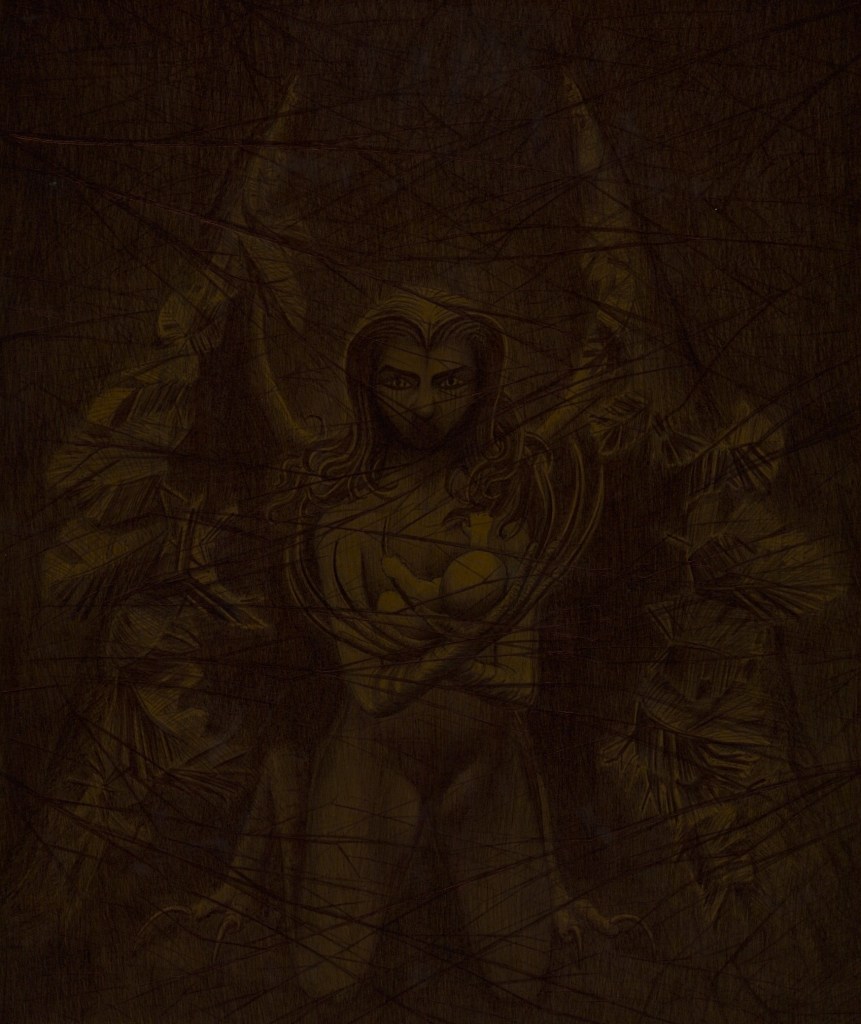
(Consumption, plate XII)
The appropriate context for the Martial is made even more difficult in the contemporary world where mechanisation has minimised the practical role of pushing one’s physical boundaries. This is perhaps where the maternal Harpetic Widow (plate XII) fails, as although the Martial is fitting for her moment of defiance, there is no need to run, little to lift or to fight. The desire for physical motion that is part of the clustered of attributes of the current that might lead to dance, a mosh pit (that post-wedding naked sprint in Deer Hunter), or the throwing of furniture. Again, we might view this as re-establishing contact with the divine for experience of the elations that are arguably part of a complete picture of purpose (spiritually fighting dragons… health in the sense that Neo in the Matrix might be healthier, as his electronic self is ju-jitsuing, to be set running on a treadmill). And from the pragmatic evolutionary standpoint this is all perversion, or as some (often Buddhists) might slur the darker sides of punk and metal ‘burning off negative emotion.’
There are other tones of the Martial which are harder to extricate from humanity; those of justice and revenge. I’m inclined to feel that, no longer being part of a bound 20-40-person group that might banish someone for transgressing the rules, the emotional vigour of ‘justice’ has a very limited place in the contemporary world; there are simply too many layers, too many strategies, too many perspectives—all poured into social media before its visibility is crushed or boomed in the churning between billionaire-whim, AI, and the utilised desires of life trying to be human. Identities are so dispersed into glam, fraudulence, shock and pragmatism, that the human structure of emotive ‘justice’ struggle to make sense.
Revenge is somewhat different. I’m surprised by war-time examples of respect between ‘enemies’, (8). While also I’ve seen plenty of interviews of soldiers in WWI where the sense of retribution for the suffering of their colleagues was clearly an important motivation (or a story grabbed in desperation to maintain composure through it all). Even though others understood those in the opposing trench as just the same as them. By my own estimation a story of righteousness is necessary to ‘revenge;’ the story is somehow incomplete if both combatants simply accept themselves as rival antlered aggressors. There is a caveat though—when the combatants/competitors acknowledge their love of the Martial current, beyond their love of victory (appearing in Tramps. at Moorley’s barn and, to some extent in the subchapter The night of geese). Where two combatants acknowledge themselves part of creating a ritual, it is hard to maintain a story of revenge. However, as worshipers of the Martial/identifying themselves as Martial, it is easy enough to imagine their destain for the non-martial—and there, by envisioning the Martial as the rightful peak of the spiritual hierarchy, they must look upon the empowered non-martial in the world about as usurpation demanding punishment; hence they display this destain to their kin, by beating the non-Martial out of each other.
Being non-possessed by Martial idealisation we must confront further questions. Prof. Robert Sapolsky has made quite provocative statements as the extent our behaviour is already neurobiologically predetermined, to the point of dismissing free will (and then ‘revenge’ cannot make any sense—as people’s actions are simply things happening as they must, and so too our vengeful emotions are things happening as they must: they are as objects experienced. One cannot be vengeful as without free as one is always passive: we are but consciousness floating in an ocean of stuff happening. I can’t go this far, I can only accept this model of us as partial. But, with a strong sense of the mysterious, I could go as far as to say we’re all very lost—all blundering around in the unknown of life; which still bur the edges off the revenge story. Yet one can imagine ‘revenge’ or ‘the adversary’ as sitting more appropriately as a relationship between the currents (current=attitude=archetype=emotive ideal), hence Daemons can never be less real than our hate of abstracted evil (Consumption, plate XI).
Sadly, this understanding that the Martial divinity might be more appropriately reset outside the context of inter-human violence doesn’t solve the problem that the world is dominated by empires, by far-off decisions of elites, and that, even for a Faramir-hearted individual who is embraces violence only with a view to a world where he can sit at home listening to Enya; where you are sure your oppressor with inflict greater horrors, resistance thought interpersonal violence is an understandable and rational response. The pacifist-idealist me can argue that non-violence will lead to a more stable peace, but being unable to present conclusive evidence for this, in a context of squabbling deities it just looks like a non-Martial current ‘got them.’
GC does raise a point of optimism in the evidence that societal collapse, rather than a descent into violence—every man for himself—chaos, can allow freedom from detrimental restraints and bring out our better nature. There are presented some contemporary examples of this (e.g. covid responses), but what limits this, and the argument that we are PreHGood at heart, is the massive extent to which the world has changed/is changing. PreHGood population estimates are vague, but well under one million; now we are over eight-thousand millions, with a significant minority living lives which are dramatically unsustainable, and most living lives which are simply unsustainable (in terms of climate/ecological damages and resource use)(9).
While the PreHGood were surrounded by incomprehensibly vast wilderness/resource with limited powers of extraction, we are not surrounded by an incomprehensively vast population of common-kin with potent powers to change the world about us until resource limitation starts to bite.
Given the unknowns we live within, it doesn’t seem sensible to posit which of the four approaches to dragons/Goliaths is best at a particular time and place. And surely individuals with greater capacity for one approach over another will be lured to a context where they’re more highly valued. But perhaps the duration of Pre-Holocene Goodlife gives it a legitimacy that can buffer something the domination of the Martial spreading far beyond its due.


Leave a Reply